I know how I personally feel when I get great customer service. There's a memory that lives rent-free in my head of a New Jersey gas station attendant that made cleaning windshields an art form. Apparently that can be a craft.
For an organization, great customer service is the best way to build brand affinity with me. It's irrational, but it's actually more powerful than the quality of the product/service itself.
Most customer service is bad though. Why?
The Comcast-Verizon experience does seem to be by design, and I can rationalize that (even if it leaves us all with a lot to be desired). But for the typical company that aspires to excellence, I think most bad customer service is just 2 things: it's hard to do well, and most businesses mis-appraise its value.
I like the idea of Tether portfolio companies' customers having strong brand affinity. That might be good for us economically.1 But affinity is a secondary source of value for an acquirer like Tether. So far, the real value has come from the leverage we've received from it, in the form of market insights.2
When Tether acquires a company, it's usually new to its market. So we're behind on the earned knowledge that the rest of our market has picked up over the years. If we don't catch up, then we can't expect to compete for very long. We can learn a lot about a market from the seller and from ChatGPT, but both have their limitations. Also, though, we're out looking for secrets - things the rest of our market hasn't discovered or can't figure out how to deliver. Great customer service happens to be the best - only? - place I've found meaningful secrets in a market.
The paradox is that most individual GCS efforts do not offer an economic ROI. The average customer does not return a secret. Most often the yield looks something like:
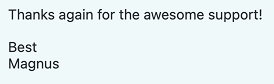
I'm proud of this every time, and I'm optimistic that brand affinity does come back around to us in some small way. But since Tether is a business and not a charity, we also have to get an economic return on the goodwill of GCS... otherwise we, too, may find ourselves on the gold-paved path to Comcast support quality hell.
Fortunately, there's good news here: a small percentage of customers will return nuggets of wisdom that are measured in orders of magnitude greater than their revenue, if they decide we're worthy of the feedback. They tend to happen in the wake of messages like this:
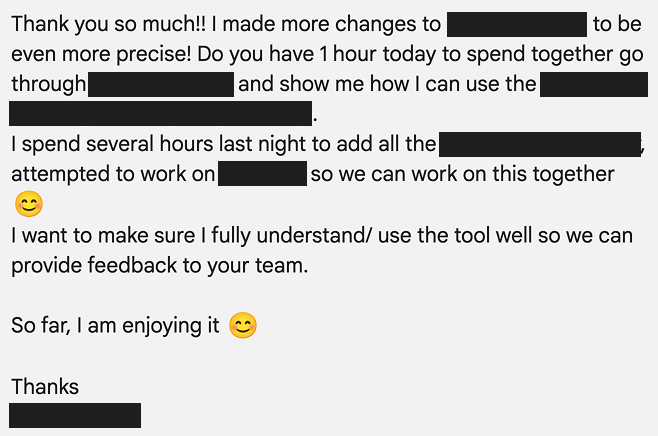
These trade secrets more than make up for the lost time on the net. Great customer service for us is analogous to what a VC is doing with their portfolio - we play a low batting average game, and occasionally hit a home run. (This low batting average also might explain the value mis-appraisal problem.)
GCS at Tether
Since we're usually new to our markets, there tends to be some urgency for an acquirer like us to catch up. So we're very interested in the practical ways to build customer relationships from scratch. Here are some ideas we've had success with:
- Excuses to create delight
As an example, one of our portfolio companies has a "Wall of Fame" for great designers. When someone uses our product well, we ask if we can put their design on the Wall. We want to interact with this person - if they've put in the effort to make something great, they might also have good perspective on what we can do better.
- Proactivity
One automation/recommendation tool we use generates a new customer service interaction about 20% of the time. It's a product feature that nudges users towards getting the most out of our product, but it's also a funnel for new customers to interact with us.
- Loom videos > email responses
The medium of exchange matters. A video with a shared screen communicates 100x an email, even if the words are the same. We've gotten faster at this, to the point where the marginal effort is about the same as email.
- Agents
An AI agent on a website is a freebie. We've found them easy to build & train, and it gives us the ability to answer faster than a human, at scale. Interestingly enough, our preliminary data shows that users are more willing to open a ticket when they know there's an AI agent. Something about the AI agent seems to lower the barrier to starting an interaction for at least one type of customer.
All of these are either ways to build relationships or doors to start them. These are where we catch up with our market, and earn our secrets. I don't know quite how to measure the economic impact, but it's a safe bet to say that it's been the biggest driver of Tether's organic (read: non-acquired) growth.
1 There's probably some non-economic benefit in the sense of purpose that comes with great service. I think it'd be hard for us to be properly long-term if money were the only driver.
2 Actually, great customer service is the only lever that I've found to actually materialize in practice after an acquisition. For all the theoretical synergies that exist - cross-selling, scaling a marketing playbook, backoffice efficiencies, etc. - GCS seems to reliably deliver.