In our investor decks, we talk about being the buyer of choice:
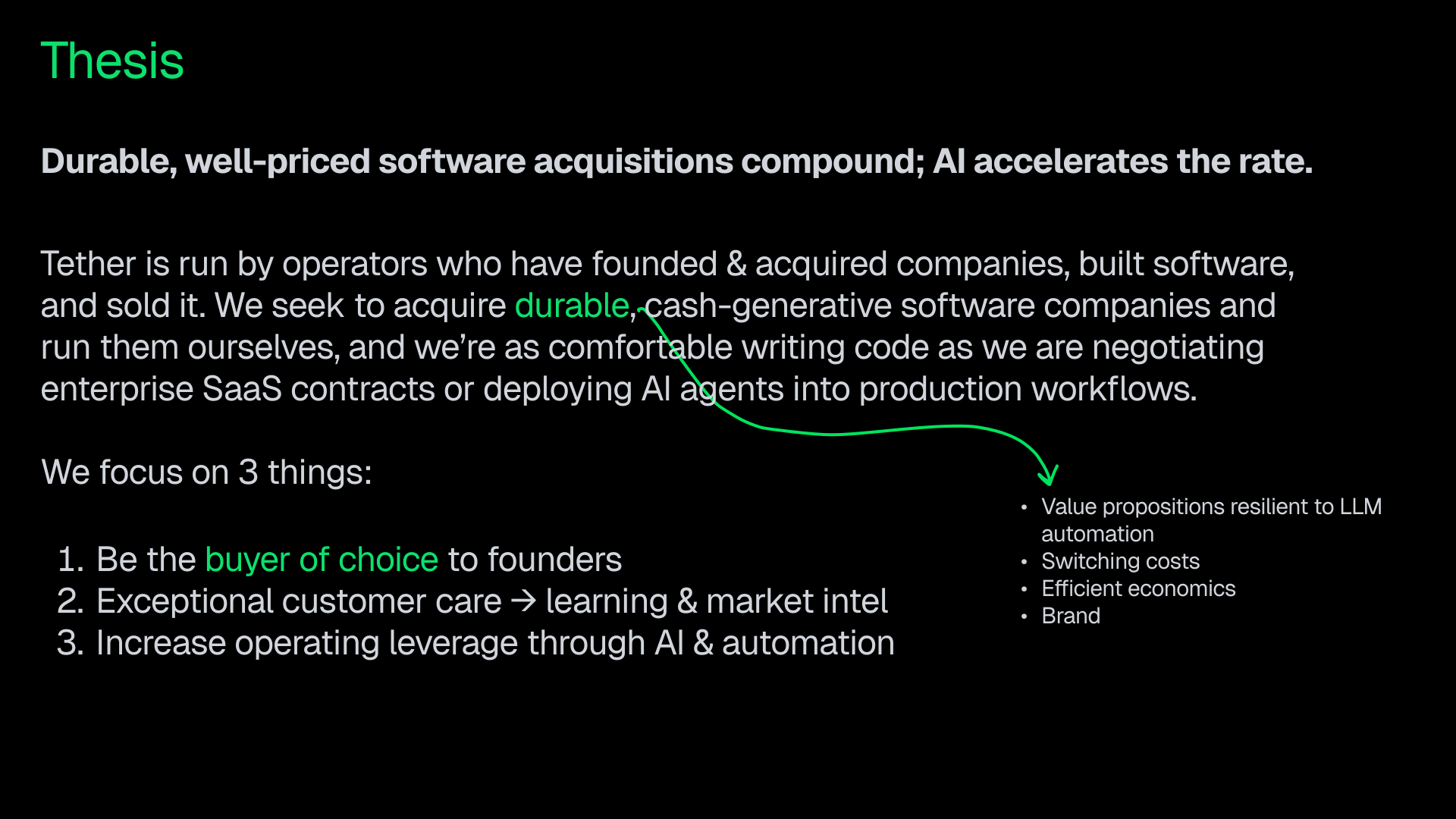
The reality is that we're 2 years old and 2 companies into building Tether. So it's hard to prove much about being the buyer of choice, or even a good one. I'll try anyway.
If I were selling Tether,1 I think these would be my ordered priorities:
- Price / economics
- I'd want to know that my customers and employees are taken care of
- I'd want Tether to have life after me. Will it still exist in 15 years? Will it have grown? Will I still be proud to say I founded it?
Since Tether is a non-strategic acquirer for all but a few companies, we probably aren't the highest-price player. But we might be able to differentiate ourselves on the latter two.
How?
The first thing that comes to mind is the inversion - red flags I might see in a person or organization that suggest I might not want to sell to them. Most are various forms of incentive misalignment.
Who I wouldn't want to sell Tether to
A fund
I think private equity is great. This is not a PE-bashing opinion piece. But I don't want to sell my company to a fund. I've put most of my time and effort into making Tether something I'm proud of - but since it's exceedingly unlikely that any buyer will love it like I do, I'd like at least to know that my buyer's incentives roughly match what mine were.
So there are 2 problems with a fund structure: first, the operators' paychecks come from the management fee (the "2" in "2 & 20"). It's true that it makes for nice incentive alignment if the company does well, but the paycheck still comes if the acquisition goes poorly. Second, a typical PE firm looks to hold a company 3-10 years for structural reasons (realize carry, LP distributions, etc.). It's hard for me to confidently predict #3 if I don't know who'll own my company 10 years from now.
A buyer who sells/flips companies
I don't think this is as much of a dealbreaker as some permanent holding companies make it out to be. But it does signal short-termism. Again - it's hard for me to confidently predict #3 here.
A manager / spreadsheet-operator
I think many financiers and career manager types would make great marketers or sellers or engineers. I just don't know how to bet on that without evidence. Fix a broken sales funnel is a bundle of ~10 different skills.
What I think this means for Tether
Since we aspire to be the buyer of choice to sellers, a good start might be to just avoid those pathways. I'm guessing that's hard, since in spite of the success of some permanent holdcos (Berkshire, Constellation, Permanent Equity, etc.), they're the exception rather than the norm. But looking at their performance, something clearly works.
I don't know all of the ingredients required to be a buyer of choice. But here are a few hypotheses that we're building Tether around:
Each of these is hard in its own way, which is why they aren't very common. So I suspect that delivering on them creates a long-term advantage.
1 This is an ironic thought experiment, given the topic of the post. For the avoidance of doubt, I have no plans to sell Tether.